Toolbox talks and hazard assessments, drafted from your crew’s texts. Your crew reviews and signs.
Your crew sends a photo of the sign-in sheet or a quick text. Your helper drafts the safety briefing on your own form, asks about anything missing, and files the signed copy with the job.
Today 10:04 AM
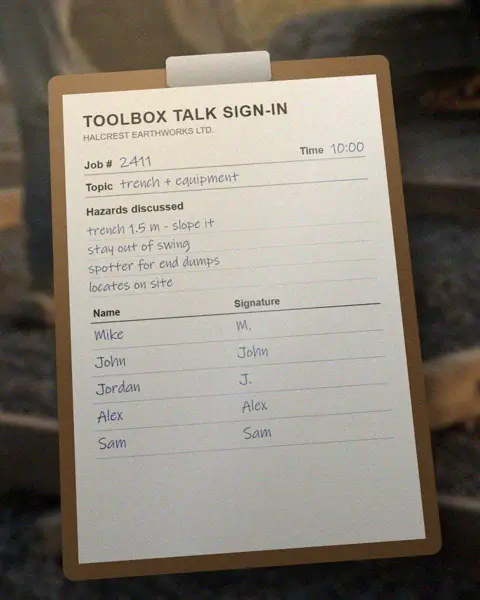
toolbox talk done
Safety briefing drafted from the sign-in sheet. One thing is missing: who is on site for the client today?
kelly from sample contracting, til noon
John, Jordan, Alex and Sam signed the briefing
All 5 signed. Filed in Job 2411 › Safety.
PDFSafety briefing, Job 2411.pdfPDF document · 240 KB
How it works
From the truck to a signed form.
The crew sends what they have
A photo of the sign-in sheet, a quick text or a voice note, in the group chat they already use. Nobody learns a new app.
Your helper drafts the form
It fills in your own toolbox talk or hazard assessment form: the job, the crew, the tasks, the hazards and the controls.
It asks about what is missing
If a detail is blank, like who is on site for the client, it asks in the chat instead of guessing.
The crew reviews and signs
Your crew lead goes over the draft with the crew, fixes anything, and everyone signs. Then the signed copy is filed with the job.
Nothing is filed or sent until your crew has checked it.
Company: Halcrest Earthworks Ltd.
Form SF-01
Rev. 2026-10
Toolbox talk / safety meeting record
| Date | Oct 27, 2026 | Time | 10:00 AM |
|---|---|---|---|
| Job site | Job 2411, east of Saskatoon | Supervisor | Mike |
| Crew lead | John | Client on site | Kelly, Sample Contracting Ltd. (until noon) |
| Topic | Trenching and working around equipment |
|---|
Discussion points
- Trench is 1.5 m deep. Slope the walls before anyone goes in.
- Stay out of the excavator swing radius. Eye contact with the operator.
- Spotter for every end dump backing up.
- Locates are on site. Hand dig near the marked lines.
Crew sign-in
| # | Name | Signature | Time |
|---|---|---|---|
| 1 | Mike | ||
| 2 | John | ||
| 3 | Jordan | ||
| 4 | Alex | ||
| 5 | Sam | ||
| 6 | |||
| 7 |
Supervisor signature
Date
Form SF-01 · Rev. 2026-10Page 1 of 1
Toolbox talks
Talk to the crew. Skip the typing.
A toolbox talk is a short safety meeting before the work starts. The crew goes over the day’s tasks, the hazards and how to control them. Then someone has to write it up on the form, get every signature and file it before the next job.
Most mornings now
- The crew lead writes it out by hand at the tailgate.
- Someone types it up later, or it stays in the truck.
- A blank line turns up when the paperwork is checked.
With your helper
- The crew lead sends a photo or a text, like they do now.
- The draft is on your form before the crew starts work.
- Blanks are asked about in the chat, while the crew is still there.
Field level hazard assessments
Every hazard row filled in or flagged.
A field level hazard assessment, or FLHA, is a check done at the work site before a task starts. The crew lists each task, the hazards that come with it, how serious each one is and the controls they will use. When the job changes, the assessment is updated.
Your helper drafts the FLHA on your own form from the crew’s notes, with the PPE boxes ticked from what the crew said. If a row is blank, it flags it so your crew lead can fill it in. The crew still walks the site, checks each hazard and control, and signs.
Company: Halcrest Earthworks Ltd.
Form SF-02
Rev. 2026-10
Field level hazard assessment
| Date | Oct 27, 2026 | Time | 10:00 AM |
|---|---|---|---|
| Job site | Job 2411, east of Saskatoon | Supervisor | Mike |
| Crew lead | John | Muster point | Site trailer, north gate |
Task steps, hazards and controls
| # | Task step | Hazards | Risk H/M/L | Controls |
|---|---|---|---|---|
| 1 | Excavate trench | Cave-in, 1.5 m deep | H | Slope walls. No entry until sloped. |
| 2 | Excavator digging | Swing radius, struck-by | H | Stay out of swing. Eye contact with operator. |
| 3 | End dumps backing | Struck-by, blind spots | M | Spotter for every dump. |
| 4 | Dig near utilities | Buried lines | H | Locates on site. Hand dig at marks. |
| 5 | Replace fill | Dust, slips | L | Water the haul road. Three points of contact. |
PPE required
- Hard hat
- Hi-vis vest
- Safety boots
- Safety glasses
- Gloves
- Hearing protection
- Respirator
- Fall protection
Workers on this assessment
| Name | Signature |
|---|---|
| Mike | |
| John | |
| Jordan | |
| Alex | |
| Sam |
Supervisor signature
Date
Form SF-02 · Rev. 2026-10Page 1 of 1
Job and crew
Job number, location, date, time, the supervisor and everyone on site.
Tasks
The work planned for today, task by task, the way your crew describes it.
Hazards
What could hurt someone on each task: the trench, the swing radius, the buried lines.
Controls
What the crew will do about each hazard: slope it, spotter, locates on site.
PPE and contacts
The gear for the job and who to reach, including the client’s person on site.
Sign-off
A line for every crew member. Nobody’s name is signed for them.
Your forms
Built around your forms, not ours.
Every contractor’s safety paperwork looks a little different. Your helper is built around the forms you already use, with your headings, your questions and your sign-off lines. If your crew fills it in on site, we can build the helper around it.
- Toolbox talks
- Tailgate meetings
- Field level hazard assessments (FLHA)
- Job hazard analyses (JHA)
- Pre-task plans
- Site orientation sign-ins
- Equipment pre-use checks
- Daily site reports
The same helper can draft your timesheets, invoices and daily site reports from the same crew texts.
What stays with you
The helper drafts. Your crew decides.
Your helper does not certify that a site is safe, and it does not replace your safety program. Your crew lead and your crew still hold the talk, walk the site and sign off. It works with the forms and the group chat you already use.
For our first clients, some simple builds are $0 up front. Bigger builds are quoted before we start, with a one-year warranty on what we build. Then a monthly subscription as low as $25/month for a team of 1 to 10, depending on use, with no per-user fees. We come on site anywhere in Saskatchewan and set it up remotely elsewhere.
Questions people ask
Straight answers.
What is a toolbox talk?
A toolbox talk is a short safety meeting on site before the work starts. The crew goes over the tasks, the hazards and the controls, then signs to show they took part. Your helper drafts it on your own form from the crew’s job notes.
What is a field level hazard assessment?
A field level hazard assessment, or FLHA, is a written check of the tasks, hazards and controls at the work site, done before the work starts. The crew updates it when the job changes. Your helper drafts it from the crew’s notes, and the crew reviews and signs it.
Can it write a toolbox talk?
Yes. It drafts the safety briefing or toolbox talk on your own form, from what the crew sends. You or your crew lead check it before anyone signs.
Can my crew send a photo of the sign-in sheet?
Yes, a photo of the sign-in sheet works. The helper drafts the briefing from it and asks in the chat about anything it cannot read or that is missing.
Which safety forms can it fill in?
It fills in the safety forms you already use. Toolbox talks, tailgate meetings, field level hazard assessments and job hazard analyses are common ones. You show us your form, and we build the helper around it.
Does it replace our safety program?
No, it does not replace your safety program. The helper only drafts the paperwork. Your crew lead and your crew still hold the talk, walk the site and sign off, and it never certifies that a site is safe.
What if the crew leaves something out?
The helper flags it instead of guessing. Your crew lead fills it in before the crew signs.
What does it cost?
For our first clients, some simple builds are $0 up front. Bigger builds are quoted before we start. Then a monthly subscription, as low as $25 a month for a team of 1 to 10, with actual use affecting cost. We explain it before you start.
Stop typing up the same toolbox talk.
Show us the safety forms your crew fills in now. We build the helper around them. The first chat is free.